
29/04/2026
Dislocation and Dispersion in High-Spread Credit
Technicals Driving Cash-CDS Decoupling While Rising Dispersion Creates a Prime Alpha Environment
Credit markets are currently exhibiting a clear bifurcation across the rating spectrum, with fundamentally different dynamics between investment grade and high-spread credit.
In US and EUR Investment Grade, cash bond spreads (OAS) and CDS indices remain highly correlated and tightly anchored, reflecting efficient market functioning, strong arbitrage activity, and balanced technicals.
In contrast, High Yield and Emerging Markets credit are experiencing a material dislocation, with cash bond spreads tightening aggressively while CDS spreads remain wider and more reflective of underlying macro risks. This divergence is not driven by improving fundamentals, but rather by powerful technical factors, including yieldchasing inflows, exceptionally strong primary market demand, and a structural rotation from private credit into liquid public markets.
At the same time, beneath the surface of tight headline spreads, there is a significant increase in dispersion across sectors, regions, and issuers, particularly within HY and EM. This reflects a market where fundamentals are diverging, liquidity is increasingly selective, and pricing is becoming less efficient.
The combination of:
• Cash-CDS dislocation, and
• Rising intra-market dispersion
creates a market environment that is both fragile and opportunity-rich.
From a valuation perspective, high-yield spreads are now tighter than pre–US-Iran conflict levels, despite a more complex and risk-prone macro backdrop, including inflation uncertainty, supply chain disruptions, and potential energy-driven demand shocks. CDS markets are effectively signaling that risk has not disappeared—only cash markets are ignoring it.
In this context:
• Passive strategies are structurally misaligned, as they cannot differentiate between fundamentally strong and weak credits and are forced into crowded trades.
• Active management becomes critical, as dispersion creates a wide opportunity set for security selection and relative value strategies.
This is not a market for beta exposure.
It is a market where alpha is driven by expertise, selectivity, and disciplined risk management.
1. Market Structure: Convergence vs Dislocation
A defining feature of current credit markets is the divergence in behaviour between investment grade and high-spread credit segments.
In US and EUR IG markets, the relationship between cash bonds and CDS remains stable and well-functioning. Spreads in instruments such as CDX IG and iTraxx Main closely track cash OAS, reflecting a high degree of arbitrage efficiency and institutional participation. These markets continue to behave in line with traditional valuation frameworks, where pricing is driven by a combination of macro fundamentals, rates expectations, and relative value.
In contrast, US High Yield, EUR High Yield, and Emerging Markets credit have experienced a clear breakdown in this relationship. Cash bond spreads have tightened materially, while CDS spreads have lagged behind, creating a persistent dislocation. This divergence becomes more pronounced as one moves down the credit spectrum, highlighting the increasing dominance of technical factors in lower-quality assets.
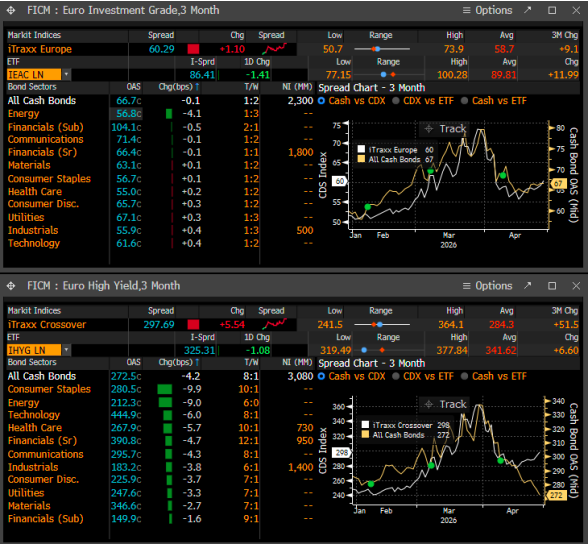
This dislocation is most pronounced in the EUR complex, where the divergence between cash bond spreads and CDS indices has widened materially, reflecting a clear decoupling between flow-driven cash markets and more macro-sensitive derivatives pricing. As shown in Chart 1 & 2 (EUR IG OAS vs iTraxx Europe & EUR HY OAS vs iTraxx Crossover), cash spreads have compressed aggressively in recent weeks, while CDS levels have remained comparatively wider, indicating that derivative markets are still pricing a higher degree of macro and credit risk than is currently reflected in cash bonds.
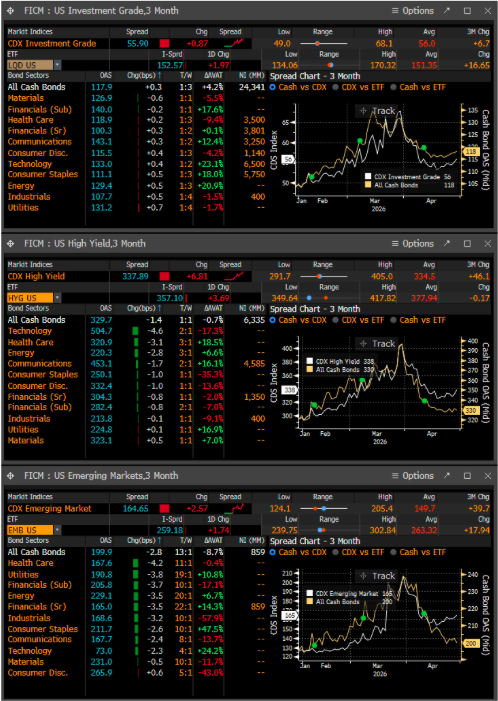
The US complex is exhibiting a similar, albeit slightly less extreme, dynamic. As illustrated in Chart 3 & 4 (US IG OAS vs CDX IG & US HY OAS vs CDX HY), cash bonds continue to tighten on the back of strong technicals and sustained demand, while CDS spreads have lagged the move, remaining anchored to broader macro uncertainty and hedging flows. This has resulted in a persistent widening of the cash-CDS basis, highlighting the growing disconnect between market pricing mechanisms.
In Emerging Markets, the divergence is further amplified by regional dispersion and liquidity fragmentation. As shown in Chart 5 (EM OAS vs CDX EM), cash spreads have benefited from selective inflows into higher-yielding segments, particularly in more liquid sovereign and quasi-sovereign names, while CDS markets continue to reflect a more cautious stance, incorporating geopolitical risks and macro volatility more consistently.
Taken together, the charts highlight a broad-based but uneven dislocation across highspread credit markets, with the degree of divergence increasing as one moves down the credit spectrum and into less liquid segments. This reinforces the view that current spread compression in cash markets is primarily technical in nature, rather than driven by a fundamental reassessment of credit risk.
Source: Bloomberg Finance L.P. as of April 29, 2026
Source: Bloomberg Finance L.P. as of April 29, 2026
2. What’s Driving the Dislocation? (Technicals, Not Fundamentals)
“HY Tourists” Chasing Yield
A key driver of the recent tightening in high-yield spreads is the influx of non-traditional credit investors into the asset class. Following the strong rally in equities after the US-Iran conflict, many investors who missed that move are now reallocating into high-yield credit as a substitute for income and total return. These investors tend to be less focused on credit fundamentals and more driven by yield and momentum, resulting in indiscriminate buying across the market. This dynamic compresses spreads without a corresponding improvement in credit quality and introduces a layer of unstable, flow-driven demand.
Exceptionally Strong Primary Market Technicals
The primary market has reinforced this trend. High-yield new issuance has been met with significant investor demand, often resulting in heavily oversubscribed deals and aggressive pricing. Investors are increasingly willing to accept tighter spreads in order to secure allocations, creating a feedback loop between primary and secondary markets. However, this tightening is largely technical in nature, as it is driven by excess demand rather than improved fundamentals. CDS markets, which are less influenced by primary issuance flows, have therefore not mirrored this move.
Rotation from Private Credit into Liquid Credit
Another important factor is the ongoing rotation from private credit into public markets, driven by a renewed focus on liquidity and transparency. As highlighted in recent market developments, investors are increasingly concerned about withdrawal restrictions and opaque valuations in private credit funds, prompting a shift toward liquid fixed income instruments.
This has resulted in record inflows into bond funds, particularly in the US, where investors are reallocating capital toward public credit markets.
These flows are structurally supportive of cash bond spreads, particularly in high-yield, but are not necessarily aligned with underlying credit fundamentals, further exacerbating the divergence between cash and CDS.
HY as an Inflation Buffer
In the current macro environment, high-yield credit is also being perceived as a relative hedge against inflation and rising rates, given its higher spread cushion compared to investment grade. This has led to incremental demand from investors seeking to balance income generation with credit risk. However, this positioning is inherently fragile in a stagflation scenario, as it assumes that spread compression can offset macro deterioration, an assumption that may not hold in a more adverse macro backdrop.
3. Valuation Disconnect: Markets Pricing Less Risk into More Risk
Despite a backdrop of increasing uncertainty—including inflation risks, geopolitical tensions, and potential supply chain disruptions—high-yield spreads have compressed to levels that are tighter than those observed prior to the US-Iran conflict.
This represents a clear valuation inconsistency, as the market is effectively pricing in lower risk in a more uncertain environment. The longer this disconnect persists, the greater the potential for a sharp repricing, particularly if technical support weakens or macro conditions deteriorate further.
4. CDS vs Cash: What the Market is Really Saying
The divergence between CDS and cash markets reflects the different roles these instruments play. CDS markets are primarily used for hedging and tend to be more sensitive to macro risks and shifts in investor sentiment. Cash bond markets, particularly in high-yield, are currently dominated by flows, liquidity conditions, and primary market dynamics. As a result, CDS spreads are currently providing a more realistic assessment of underlying risk, while cash markets are being distorted by technical demand. This suggests that the eventual resolution of the dislocation is more likely to come from cash spreads widening rather than CDS tightening.
5. Rising Dispersion: The Hidden Story Beneath Tight Spreads
Beneath the surface of tight index-level spreads, there is a significant increase in dispersion across high-yield and emerging markets.
Sectoral performance is diverging, with industries reacting differently to macro developments such as commodity price movements and shifting demand patterns. At the issuer level, companies with similar credit ratings are trading at meaningfully different spread levels, reflecting differences in balance sheet strength, liquidity, and exposure to macro risks. In emerging markets, regional dynamics are further amplifying dispersion, with distinct outcomes across Latin America, CEEMEA, and Asia.
This highlights a market that is increasingly fragmented, where aggregate indices mask a wide range of underlying credit conditions.
6. Why Dispersion is Increasing
Dispersion is being driven by a combination of flow distortions, macro divergence, and liquidity bifurcation.
Large inflows into the asset class are being deployed in a relatively indiscriminate manner, compressing spreads across more liquid and benchmark names, due to the use of ETF and passive instruments by asset allocators. At the same time, macro risks are affecting issuers unevenly, creating winners and losers within the same rating categories. Liquidity conditions further reinforce this divergence, as demand is concentrated in larger, more liquid securities, leaving smaller or more complex credits relatively under-owned.
The result is a market where pricing inefficiencies are increasing, and where spreads are no longer a uniform reflection of risk.
7. Dispersion = Alpha
In this environment, dispersion becomes the primary driver of alpha. Unlike highly correlated markets, where returns are largely driven by beta, a dispersed market allows active managers to generate outperformance through security selection and relative value strategies.
The current combination of technical dislocation and fundamental divergence creates a rich opportunity set, particularly in high-yield and emerging markets. Identifying mispriced credits—whether overly tight or unjustifiably wide—requires deep expertise and disciplined analysis, but offers the potential for significant excess returns.
8. Passive Strategies: Structurally Misaligned
Passive strategies are ill-equipped to navigate this environment. By design, they allocate capital based on index weights rather than fundamentals, often resulting in an overweight to the most indebted issuers. In a market characterized by dispersion and inefficiency, this leads to suboptimal exposure and increased downside risk.
Moreover, passive vehicles are inherently pro-cyclical, amplifying market trends during both tightening and widening phases. In the event of a reversal in flows, they can exacerbate market moves through forced selling and liquidity mismatches.
9. The Key Risk: Technical Reversal
The current market equilibrium is heavily dependent on continued technical support, including strong inflows and robust primary demand. Should these factors reverse, the market could experience a rapid and disorderly repricing.
In such a scenario:
• Cash spreads would likely widen sharply
• CDS markets would lead the adjustment
• The current basis dislocation would normalize quickly
This underscores the fragility of the current environment and the importance of active risk management.
10. Forward View: Resolution Likely Through Cash
Repricing In our view, the current dislocation is unlikely to resolve through a tightening of CDS spreads. Rather, the more probable path is a repricing wider in cash spreads, particularly across high-yield and lower-liquidity segments, as technical support from inflows and primary market strength begins to fade or becomes less effective. While the timing of such an adjustment is inherently uncertain, the current combination of elevated macro risk, stretched valuations, and flow-driven positioning suggests that the asymmetry is skewed toward widening rather than further tightening. Importantly, given the current market structure—characterized by concentrated positioning and reduced liquidity depth—the adjustment is unlikely to be linear and may instead occur through periods of abrupt spread widening, particularly in more crowded segments of the market.
11. ACA Positioning: Built for This Market
ACA’s investment approach is specifically designed to navigate environments characterized by dislocation and dispersion.
The strategy focuses on:
• High-spread segments where inefficiencies are greatest
• A disciplined framework incorporating fundamentals, technicals, and valuation
• A proven investment process based on the Five Risk Buckets methodology
ACA’s track record demonstrates consistent outperformance across cycles, driven by active management and deep credit expertise.
Final Take
The current market is defined by the coexistence of technical dislocation and structural dispersion.
Cash markets are being driven by flows, while CDS markets continue to reflect underlying risk. At the same time, dispersion across high-yield and emerging markets is creating a highly inefficient pricing environment.
This is not a market for passive exposure.
It is a market where:
• Selection matters more than allocation
• Relative value drives performance
• Expertise determines outcomes
Dislocation creates risk. Dispersion creates opportunity — but only for those equipped to capture it.